
It’s the middle of winter. You applied moisturiser before leaving home. Your skin felt comfortable, healthy, and hydrated. By 3pm, everything feels different.
The skin around your mouth feels tight. Your foundation suddenly looks uneven and cakey. The area beneath your eyes feels tired and dehydrated, despite the effort you’ve already put into your routine.
For many people, this is the moment another layer of moisturiser goes on. And then another. But the tightness, it just keeps returning.
The frustration is rarely a lack of effort. Most of us experiencing winter dehydration are already moisturising consistently. We’re simply trying to solve a hydration problem with moisture alone. Understanding the difference is where winter skin with HA Contour Masque support starts making sense.
When “Dry Skin” Isn’t Actually Dry Skin
Winter can make almost every skin concern feel like dryness. Skin feels tight after cleansing. Fine lines appear more noticeable. Texture becomes uneven. Makeup sits differently. So naturally, we assume our skin needs more moisturiser.
But dryness and dehydration are not always the same thing.
Dry skin refers to a lack of oil. Dehydrated skin refers to a lack of water.
| Dry Skin | Dehydrated Skin |
| Lacks oil | Lacks water |
| Often genetic | Environmentally induced |
| Can feel rough | Can feel tight |
| Needs lipid support | Needs hydration support |
| Persistent | Fluctuates seasonally |
While both feel uncomfortable, the support approach should be different.
This distinction becomes particularly important during winter, when environmental conditions significantly affect the skin’s ability to retain water.
The Winter Habits That Quietly Dehydrate Skin
Winter dehydration isn’t caused by one single factor. Instead, it develops through a collection of small daily habits that seem harmless.
- The extra-hot shower on a cold morning.
- Having the heater running throughout the workday.
- The dry indoor air that feels comfortable but gradually draws moisture from the skin.
- Even moving between heated indoor spaces and cold outdoor temperatures.
These changes create increased transepidermal water loss, where water escapes from the skin faster than it can be replenished. By the time your skin starts feeling tight, the process has often been underway for hours.
Adding More Products Doesn’t Address the Problem Beneath
When your skin feels uncomfortable, the most natural response is to add more product. Maybe a richer cream, an extra layer before bed, or a heavier moisturiser around the eyes. While these approaches can provide temporary comfort, they don’t always address the underlying issue.
Think of hydration like a reservoir rather than a bucket.
If the walls of a reservoir are strong, water remains available when needed. If those walls become compromised, constantly adding more water becomes less effective because retention is the real challenge.
The skin barrier functions in a similar way.
Healthy hydration not only depends on how much moisture is applied, but also on how effectively the skin can retain and utilise it.
Hydration Happens Below the Surface
One of the biggest misconceptions in skincare is that hydration happens on the surface. Effective hydration skincare works within the skin’s structure itself.
Water needs to be attracted, held, and distributed throughout multiple layers of the skin to maintain its elasticity, comfort, and resilience. This is why ingredients that support water-binding capacity have become such an important part of modern hydration science.
Rather than simply coating the skin, they help improve how hydration is managed from within.
Why Hyaluronic Acid Became a Winter Essential
Hyaluronic acid has become one of the most recognised hydration ingredients in skincare, but its value extends far beyond simply adding moisture. Its unique ability to bind water helps support hydration throughout the skin while improving barrier comfort, elasticity, and function. What makes the process particularly effective is how it works at multiple levels of the skin simultaneously.
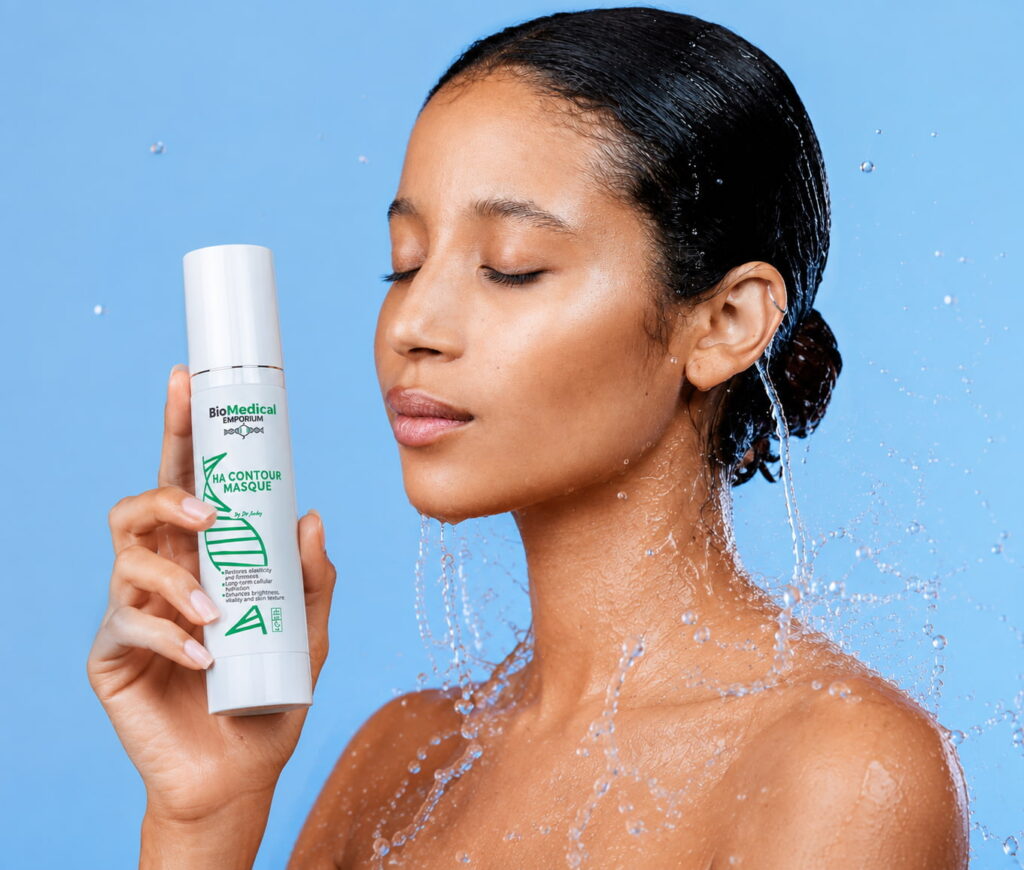
This is where BioMedical Emporium’s HA Contour Masque offers a more comprehensive approach to winter hydration. Rather than delivering a single level of moisture support, the masque uses multiple molecular weights of hyaluronic acid to support hydration across the different dermal layers.
The result is hydration that feels both immediate and sustainable.
Not All Hydration Works the Same Way
Your skin isn’t a single uniform surface. Each of the different layers has different hydration needs, which is why multi-molecular hydration technologies have become increasingly important.
High molecular weight hyaluronic acid helps create a protective hydration reservoir near the skin’s surface.
Medium molecular weight molecules support moisture retention within the upper stratum corneum (the outermost layer of the dermis).
Lower molecular weight forms can penetrate more deeply, supporting elasticity and longer-term skin resilience where dehydration starts.
This layered approach is one of the reasons the HA Contour Masque has become such a valuable addition to winter skincare routines.
Rather than treating dehydration at the surface level only, it supports hydration more holistically.
The First Places Winter Dehydration Appears
The earliest signs of dehydration appear in areas where the skin is naturally thinner.
Around the eyes. Around the mouth. Across the lips.
These areas tend to reveal barrier stress long before the rest of the face catches up. Many people notice that concealer settles differently beneath the eyes or that fine dehydration lines become more visible during winter.
Targeted support like BioMedical Emporium’s Eye Patches can help reinforce hydration in these vulnerable areas while complementing broader hydration support from the HA Contour Masque.
Understanding why lip care belongs in every skincare routine becomes even more relevant during winter, when dehydration can appear around the lips first.
Hydration Works Best as a System
Hydration is foundational, but healthy skin requires more than water. Once hydration levels improve, the skin is better equipped to benefit from other supportive ingredients.
To help defend against oxidative stress that can weaken the barrier over time, a Vitamin C Concentrate is a great supporting layer. For improved cellular communication and structural resilience, the Peptide Therapy helps to maintain healthier skin function overall.
Rather than competing with hydration, these ingredients work alongside it. The healthiest skin is rarely supported by one ingredient alone. It is supported by systems that work together.
Hydration is easier to maintain when the barrier is protected. This is why skipping SPF in winter damages skin. To improve protection from environmental stress and support the barrier’s ability to retain moisture more effectively, SPF protects the skin’s reservoir.
Hydration Is About Retention, Not Reapplication
Winter skin often encourages us to reach for more products, richer creams, and heavier layers. Sometimes that support may be necessary, but lasting hydration rarely comes from volume.
It comes from helping the skin attract, retain, and utilise water more effectively. When hydration is supported at a structural level, comfort is more consistent, resilience improves, and the barrier function is supported.
The interesting thing about hydration is that we only tend to notice it when it’s missing. Tightness, flaking, irritation, and discomfort are often the skin’s way of signalling that balance has already been lost.
Healthy hydration is not a surface event. It’s a reflection of how well the skin functions beneath it.